Home › Road, Street, and Municipal Paving
Partner with experienced road paving contractors in St Louis, MO for reliable streets and municipal pavements. We provide new construction, resurfacing, and repairs for public roads, subdivisions, and private streets. Our crews manage traffic control, milling, paving, and compaction to deliver smooth, durable driving surfaces.
Precision Asphalt St. Louis provides professional road paving throughout St Louis, MO, Missouri and the surrounding area. Our licensed, insured crew delivers safe, clean, on-time work with a free estimate before anything begins. Call (314) 333-7779 or request your free quote.
Road, Street, and Municipal Paving in St Louis, MO
Road paving in the St Louis area is not a one-size-fits-all job. Different traffic volumes, soil conditions, and municipal standards all affect how a street is designed and built. Precision Asphalt St. Louis focuses on road, street, and municipal paving projects that have to perform under real St Louis conditions, from heavy freeze-thaw cycles to summer weeks over 95 degrees.
We work with cities, counties, engineering firms, and private developers throughout the metro to plan and execute paving projects that meet specification and stand up to traffic. Our crews are familiar with local ordinances, MODOT standards, and utility coordination requirements, which keeps projects moving and reduces costly change orders.
Whether you are rebuilding a neighborhood street, adding a private access road in an industrial park, or resurfacing a municipal connector, we tailor the pavement structure to the actual use. That means combining correct base depth, asphalt mix, and drainage design instead of relying on a generic section pulled from a textbook.
How Professional Road Paving Actually Gets Done
Quality road paving starts long before the first ton of asphalt arrives. For most street and municipal projects in St Louis, the process with Precision Asphalt St. Louis looks like this:
1) Evaluation and coring: We inspect the existing pavement, subgrade, and drainage. When needed we perform pavement cores so we know exactly what thicknesses and materials we are working with and if full-depth reconstruction is required.
2) Survey and layout: Our team verifies grades, curb lines, and tie-in points to existing streets. This is critical in older St Louis neighborhoods where elevations have shifted over decades and storm inlets are not at standard heights.
3) Subgrade preparation: We undercut soft or pumping areas, recompact, and add geotextile or geogrid where soils are weak. In areas along the river or known fill sites, we are especially cautious because saturated clays can cause premature failures if not corrected.
4) Base installation: We typically use compacted rock base (often CA-06 or similar aggregate) placed and compacted in lifts. For heavier truck routes or bus lines we may increase base thickness and use larger aggregate to distribute loads.
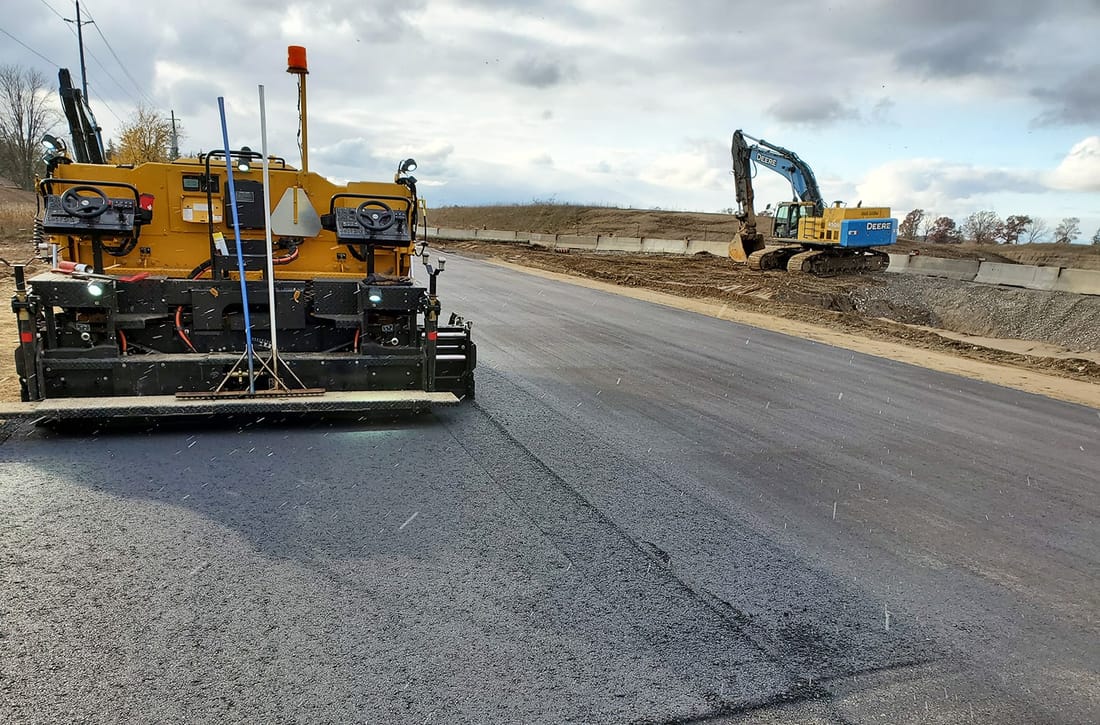
5) Asphalt placement: Depending on design, we place binder and surface courses in one or multiple lifts. Each lift is laid with a paver for smoothness, immediately compacted with steel and pneumatic rollers, and checked for density with nuclear or non-nuclear gauges.
6) Joint and transition care: Tie-ins to existing streets, manholes, and concrete gutters receive extra attention. We mill and taper these transitions so drivers do not feel a bump and so water does not pool at the joint.
7) Final striping and signs: Once the asphalt has cooled and cured sufficiently, we install markings and symbols per MUTCD and local requirements, including crosswalks near schools or transit stops.
Material Options and Pavement Design Choices
One difference with Precision Asphalt St. Louis is that we do not push a single mix or structure for every road paving project. Instead we match the design to traffic loading, budget, and maintenance expectations.
For residential streets and subdivision roads, we often recommend a slightly thicker surface course made with a fine graded mix. This gives a smoother, quieter ride for cars and bicycles and hides minor settlement better over time. For collector roads and industrial access streets we may specify a stiffer binder course below the surface to resist rutting from buses, delivery vehicles, and semi traffic.
In some locations we combine asphalt with concrete elements. For example, we might use concrete at intersections or bus stops where vehicles brake and turn, then transition to asphalt on the straight segments. That hybrid approach often reduces lifecycle costs in busy St Louis corridors.
Additives are another tool. Polymer modified asphalts can improve resistance to rutting and cracking, which matters on south-facing hills where summer sun bakes the pavement. We may suggest these mixes on slopes or high-volume approaches even if the rest of the route uses standard hot-mix asphalt. Every recommendation is grounded in actual experience with local pavements that we have watched perform over many years.
Cost Drivers for Road, Street, and Municipal Paving
Project cost for road paving in St Louis is controlled by more than just asphalt tonnage. When Precision Asphalt St. Louis develops pricing, we look carefully at several major factors so you understand what is driving the numbers.
Existing conditions: Streets that have alligator cracking, repeated potholes, or depressions usually have deeper base or subgrade issues. These require milling deeper or full-depth reconstruction, which is more expensive than a simple overlay. Skipping this step to cut cost nearly always shortens pavement life.
Traffic management: If work must occur at night, under lane closures on a busy arterial, or around Metro bus routes and emergency access, traffic control costs increase. That includes flaggers, barricades, detour signage, and off-duty police if required by the municipality.
Thickness and structure: A 2 inch overlay on a sound base is significantly cheaper than a complete rebuild with 8 inches of rock and multiple asphalt lifts. However, choosing a structure that is too thin for truck traffic can double your long-term cost due to early failure.
Utilities and drainage: Adjusting manholes, valve boxes, inlets, and curb lines adds both time and material. In older parts of St Louis, it is common to find conflicting utility elevations, so we allow for additional adjustments instead of surprising you mid-project.
Specification level: Work under formal municipal or MODOT specifications may require specific material certifications, testing frequencies, and documentation. These quality controls are valuable but do add some cost. We itemize these requirements so stakeholders understand what they are paying for.
Common Road Paving Issues in St Louis and How We Address Them
Regional climate and soil are two major reasons St Louis roads fail early. Precision Asphalt St. Louis structures each road paving project to handle these conditions instead of ignoring them.
Freeze-thaw cycles: Our winters include frequent freezing and thawing, not a single long freeze. Water that seeps into cracks expands and contracts, which breaks pavement apart. To combat this, we focus on tight compaction, correct joint construction, and surface slopes that move water quickly to inlets.
Clay subgrades: Many local neighborhoods are built on expansive clays that hold water. If these are not stabilized, the road will heave in winter and settle in summer. We may add lime or cement stabilization, or use geotextiles under the base rock in problem areas identified during our evaluation.
Drainage and gutter mismatch: In older streets, pavement has often risen or settled away from the gutter lip. Water then runs along the edge and penetrates the base. When we mill and pave, we correct these cross-slopes and, when needed, adjust or replace sections of curb and gutter.
Heavy localized loads: Fire trucks, trash trucks, and delivery vehicles tend to follow the same wheel paths. You see this as ruts in front of loading docks or subdivision entrances. In those zones, we may use heavier-duty mixes, thicker sections, or even full-depth asphalt to strengthen those wheel paths.
Utility cuts: Poorly repaired utility trenches are a common weak spot. We coordinate with utility owners, square up and recompact trench areas, and use proper joint detail so the patch functions like the surrounding pavement rather than becoming a recurring pothole.
What Municipal and Private Owners Should Decide Before Paving
A smooth final surface is important, but long-term performance depends on decisions made at the planning stage. Precision Asphalt St. Louis helps cities, HOAs, and private facility managers in St Louis think through these points before a road paving contract is awarded.
Traffic and load expectations: Knowing whether the street will primarily serve passenger cars or heavy trucks directly affects design. For example, a cul-de-sac in a residential subdivision with only trash trucks and school buses may need a different structure than a distribution center entrance.
Service life target: Is the goal a low upfront cost with an 8 to 10 year life before major work, or is the priority a thicker structure that can last 15 to 20 years with routine maintenance only? We can provide several options with projected maintenance schedules for each.
Future utility work: If a water main replacement is likely in the next few years, it can be smarter to stage paving in phases or use a surface treatment that is easier to cut and restore. Coordination with public works and utility owners reduces the risk of having a new road quickly cut open.
Drainage strategy: Even the best asphalt fails if water has no controlled path. Early agreement on where water should go, and whether additional inlets or grading changes are needed, helps avoid late design changes that affect cost.
Access requirements: Schools, hospitals, fire stations, and businesses often cannot fully close access. We plan phasing that maintains emergency routes and, when required, builds temporary surfaces or alternate entries to keep operations running.
Why Choose Precision Asphalt St. Louis for Road Paving
For road, street, and municipal paving, you need a contractor that understands both technical specifications and real-world constraints in St Louis. Precision Asphalt St. Louis combines experienced crews, accurate estimating, and project management that respects public impact.
We are local, so we know which neighborhoods have soft subgrades, where drainage is a repeat problem, and what specific details each municipality expects during inspections. That familiarity reduces delays and rework. Our equipment fleet includes modern pavers, a range of rollers, and milling machines sized for city streets as well as longer runs, so we can match production rates to your schedule and traffic control plan.
On every project we provide clear communication, from initial pavement assessment through punch list. Owners receive straightforward recommendations, not upselling. If a road can be preserved with an overlay, we say so. If a section truly needs full-depth replacement, we explain why and document the conditions.
Most important, our work is visible in pavements across the St Louis region that are still performing after years of real traffic and weather. When you are responsible for public funds or facility access, that track record matters more than a low initial bid.